She came in for stomach problems.
At least, that’s what she thought it was.
A woman in her early 50s. Menopausal for over a year. A long history of severely painful periods, chronic digestive issues, daily belly bloat, a celiac diagnosis, and a recent uterine ablation to manage years of heavy, debilitating bleeding. She’d had every scan imaginable — CT scan, liver scan, gallbladder scan, full blood work panels. All of it came back normal.
And yet she was far from okay.
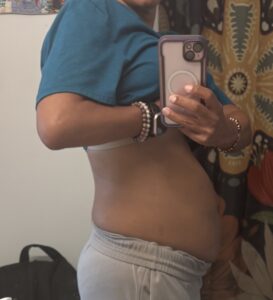
Daily abdominal pain. Severe bloating so bad she couldn’t lay flat. She would wake in the morning with a completely flat belly and by the afternoon it looked like this picture. Full, round, and tender. Cramping and spotting that had returned despite being a full year into menopause. Crushing fatigue. Brain fog thick enough to make simple tasks feel impossible. She feels lucky to have a work from home job so as to not have to sit upright at a computer all day every day.
For years, she’d been passed from one doctor to the next, each one looking at their piece of the puzzle and sending her home with the same message: nothing’s wrong.
What happened next is both frustrating and, ultimately, a story of what’s possible when someone finally refuses to accept the wrong answer.
When the whole picture tells a different story
When she came to us at Health Pointe Jacksonville, something stood out right away.
Not just one symptom. The whole picture.
A lifetime of periods so painful they kept her home from work — the kind she was told were “just bad periods.” Heavy bleeding that eventually led to a uterine ablation. Digestive chaos that had never fully resolved, even after years of managing her celiac diagnosis carefully. And now, more than a year into menopause, her body was sending new distress signals that weren’t adding up.
Here’s what the scans didn’t — and often can’t — show:
Endometriosis is a condition where tissue similar to the uterine lining grows outside the uterus — on the bowel, the bladder, and surrounding pelvic structures. It causes chronic inflammation, pain, and symptoms that look almost identical to gastrointestinal disease. Like chronic gastritis. Like IBS. Like “stress.” It is consistently and significantly underdiagnosed — with the average woman waiting 7 to 10 years to receive a correct diagnosis.
Adenomyosis is when that same type of tissue grows into the muscular wall of the uterus itself — causing heavy bleeding, pelvic pressure, pain, and bloating that can persist even after procedures like uterine ablation. Because the ablation addresses the uterine lining, not the disease process within the muscle.
Neither condition shows up reliably on standard imaging. Both are frequently fragmented across specialties — the GYN sees one piece, the gastroenterologist sees another, and nobody connects the full picture. And both can remain active — even worsen — during perimenopause, when estrogen fluctuates dramatically before finally declining.
This woman’s history didn’t look like a stomach problem when you stepped back far enough to see all of it.
It looked like decades of undiagnosed disease.
The appointment that should have changed everything — and didn’t
With a clearer clinical picture forming, I referred her to both a local endometriosis and adenomyosis specialist and a new OB-GYN. But first, she had a regularly scheduled appointment already on the calendar with her current OB-GYN.
She went. She brought her symptoms. She shared her story — the bloating, the cramping, the spotting, the pain she couldn’t escape.
The response?
“It’s just a natural part of aging.”
No further testing. No referral. No acknowledgment that a postmenopausal woman experiencing monthly cramping, spotting, and abdominal pain severe enough to prevent her from lying flat might deserve a second look.
Just sent home.
If you have ever sat in a doctor’s office and been told some version of this — it’s your age, it’s your hormones, it’s just stress, it’s just how it is — I want you to know something important:
That is not a diagnosis. That is a dismissal.
And you deserve better.
What happened when she stopped accepting that answer
She left that appointment. And this time, instead of going home discouraged, she drove directly to the referred specialist’s office.
She walked in and asked for an appointment.
As it happened, there had been a cancellation. Thirty minutes later, she was sitting in front of a physician who specializes in endometriosis and adenomyosis.
That doctor recognized her symptoms immediately.
Chronic daily abdominal pain. Bloating severe enough to prevent lying flat. A postmenopausal woman with returning monthly cramping and spotting. Crushing fatigue. Brain fog. A history of severely painful periods, heavy bleeding, uterine ablation, and unresolved GI symptoms.
The new physician ordered a pelvic ultrasound, blood work, and a CT scan. She counseled her on the possibility of laparoscopic surgery — the gold standard diagnostic and treatment procedure for endometriosis.
For the first time in decades, this woman left a medical appointment feeling seen. Heard. Believed.
Not because her symptoms were new. They weren’t. She had been describing them for years.
Because this time, someone was actually listening.
The role acupuncture has played — and what it can and can’t do
I want to be straightforward about something, because this matters.
Acupuncture is not a cure for endometriosis or adenomyosis. No responsible practitioner should tell you otherwise.
But here’s what it has done for this patient during her treatment course at HPJ:
- Significantly reduced daily bloating and pain
- Improved her energy levels
- Reduced systemic inflammation enough that she can now lay flat — something she couldn’t do when she first came to us
- Helped regulate her nervous system, which was understandably in overdrive after years of chronic pain and medical dismissal
- Improved her overall quality of life while the diagnostic process moved forward
The belly bloat is better, but still remains. We’re not done. But she’s moving in the right direction — and now she has a medical team that finally matches the level of care she deserved all along.
This is what integrative care is supposed to look like. Not acupuncture instead of proper medical diagnosis. Acupuncture alongside it — filling the gaps, improving quality of life, and addressing the inflammation and nervous system dysregulation that conventional medicine doesn’t always have tools for.
Why this happens — and why it keeps happening
This story is not an outlier. It is the rule.
Research consistently shows that endometriosis takes an average of 7 to 10 years to diagnose. The number is likely even higher for adenomyosis, which has historically been even less understood. The barriers are systemic: women’s pain has been chronically minimized in medical settings, standard imaging misses these conditions regularly, and symptoms are spread across specialties in a way that makes it easy for the full picture to stay invisible.
Add perimenopause and menopause into the equation, and symptoms get chalked up to “hormonal changes” or “just aging” — which means women in their late 40s and 50s are among the most underserved in this particular diagnostic gap.
The women who fall through these cracks are not rare cases. They are sitting in clinic waiting rooms right now, having their pain explained away, wondering if they’re overreacting.
They are not overreacting.
Warning signs that deserve a closer look — at any age
If you recognize yourself in any part of this story, these are the symptoms worth bringing to a specialist who understands endometriosis and adenomyosis:
- A lifelong history of severe, debilitating period pain
- Heavy periods that required intervention — ablation or hormonal suppression
- Persistent pelvic pain or pressure that didn’t fully resolve after ablation
- Chronic GI symptoms — bloating, constipation, diarrhea, or pain with bowel movements — that don’t fully respond to dietary changes
- Pain that worsens cyclically, even in perimenopause or after menopause
- Returning spotting or cramping after menopause
- Deep pelvic aching, heaviness, or a feeling of fullness
- Severe bloating disproportionate to food intake
- Crushing fatigue and brain fog tied to inflammatory flares
- Pain with intercourse — especially deep
- Bladder urgency or pressure
These are not normal. They are not “just aging.” They deserve real answers.
What to do if you’ve been dismissed
First: Trust yourself. You know your body. If something feels wrong, it is worth pursuing.
Second: Seek out a specialist. Not all OB-GYNs have deep expertise in endometriosis or adenomyosis. Look specifically for a provider with experience in these conditions — ideally one who offers or refers for laparoscopic evaluation.
Third: Consider integrative support while you navigate the diagnostic process. Acupuncture, pelvic floor therapy, and anti-inflammatory strategies can meaningfully improve quality of life and help manage the nervous system burden of chronic pain — even before a diagnosis is confirmed.
Fourth: You don’t have to fight this alone. At Health Pointe Jacksonville, we work alongside your medical team. We take your history seriously. We ask the questions that don’t always get asked. And we believe you — from the very first appointment.
You have every right to keep asking
This patient spent decades being told her pain was manageable. Normal. Expected.
She walked out of her most recent dismissal — and drove herself to get the help she was owed.
That took courage. And it is changing everything.
If you’ve spent years searching for answers and haven’t found them yet, we want to be part of your team. We can’t promise we’ll have all of them. But we will listen. We will look at the whole picture. And when we see something that needs a different kind of attention, we’ll say so — and we’ll help you get there.
Your pain is real. It was never “just aging.” And it is not too late.
Ready to be heard? Call us or book online. Your body has been waiting long enough.
 (904) 448-0046

 3840 Belfort Road #305, Jacksonville, FL 32216
With love and support,
Dr. Julee Miller, AP, Doctor of Acupuncture and TCM, FABORM
Health Pointe Jacksonville Acupuncture + Wellness Clinic